
Written By Dr Bjorn Thomas | Last Updated March 2026
Noticing a new, raised patch on your skin that appears as though it is “stuck on” the skin surface can be unsettling, especially if it changes texture, flakes, or catches on clothing.
This kind of patch on the skin could indicate the presence of Seborrheic Keratosis (also commonly spelt Seborrheic Keratoses). If this is the case, rest assured that they are among the most common and benign skin growths, but they can still cause worry because they sometimes resemble other lesions. This emphasises the importance of getting any new or suddenly altered skin growths properly assessed by a medical professional.
In this article, we explain what Seborrheic Keratosis are, how they can appear to fall off and how this is not something you should rely on in terms of healing. We also discuss seborrheic keratosis, NHS guidance generally focuses on, and the safest ways to approach removal, including laser treatment for Seborrheic Keratosis. You’ll also learn why trying to remove Seborrheic Keratosis at home can be risky.
Key Takeaways
- Seborrheic Keratoses are benign (non-cancerous) skin growths caused by a build-up of skin cells and are extremely common with age.
- Occasionally, this type of skin growth may partially crumble, flake, or detach after irritation, but most do not simply disappear on their own.
- The key safety point: not every “stuck-on” lesion is a Seborrheic Keratosis, so self-diagnosis and self-removal can delay diagnosis of something more serious.
- The NHS commonly treats Seborrheic Keratosis as a cosmetic issue unless there are clinical concerns (e.g., diagnostic uncertainty, persistent bleeding/trauma to the affected area).
- In-clinic removal options can include cryotherapy, curettage/shave removal, and cautery. In selected cases, dermatologists use laser treatment for Seborrheic Keratosis for a precise cosmetic result.
Jump to Section
- What Is Seborrheic Keratosis?
- Can Seborrheic Keratosis Fall Off?
- What Seborrheic Keratosis NHS Guidance Commonly Emphasises.
- Why Seborrheic Keratosis Can Look Concerning.
- Asking How to Remove Seborrheic Keratosis at Home?
- Treatment Options in-Clinic, Including Laser Treatment for Seborrheic Keratosis.
- What to Expect After Removal: Healing and Aftercare.
- Seborrheic Keratosis Frequently Asked Questions.
- Book an Assessment at the Thomas Clinic.
- Useful Medical Resources for Information on Seborrheic Keratosis.
What Is Seborrheic Keratosis?
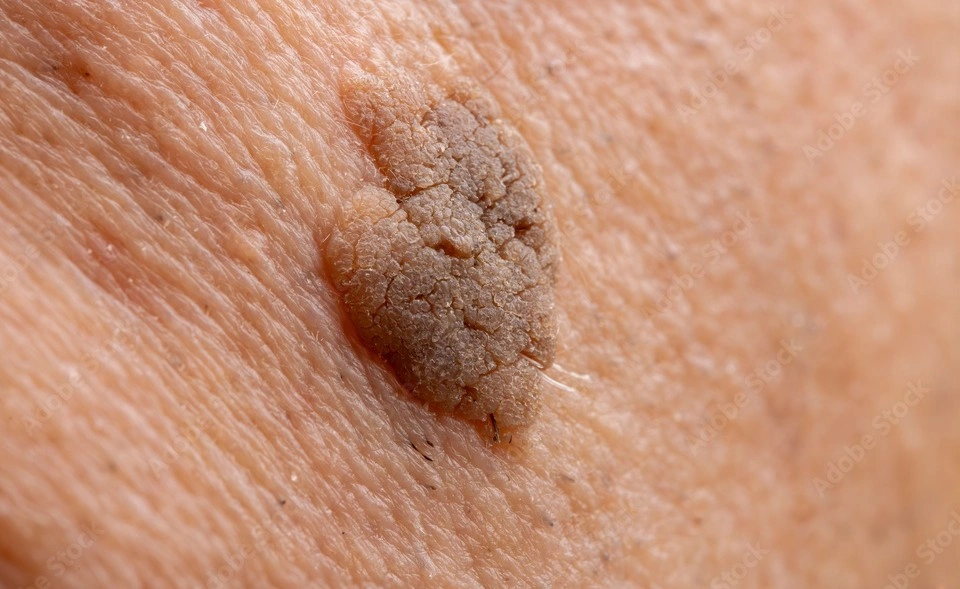
Seborrheic Keratosis (seborrheic warts) are very common, harmless skin growths that develop when ordinary skin cells build up on the surface. They can appear anywhere on the body (often the trunk), and tend to become more common from midlife onwards.
They’re often described as:
- Waxy, warty, or “stuck-on” in appearance.
- Light tan, brown, grey, or nearly black.
- Slightly raised or more prominent over time.
- Smooth, crumbly, or rough-textured.
- Sometimes itchy or easily irritated if rubbed by clothing or jewellery.
The reassuring news: Seborrheic Keratosis is not skin cancer and does not turn into skin cancer. That said, because they can mimic other lesions (and other lesions can mimic them), it’s sensible to get an expert opinion if you’re unsure.
Can Seborrheic Keratosis Fall Off?
Let’s address the exact question: can seborrheic keratosis fall off?
When It Can Seem to “Fall Off”
Seborrheic Keratoses sit on the surface of the skin and can become more fragile over time.
In some situations, they may:
- Flake, crumble, or shed small pieces (especially if they’re dry or irritated).
- Catch on clothing, shaved hair, or jewellery and partially tear.
- Form a scab after repeated rubbing or scratching, then lift it away from the skin.
In those cases, it can look as though the lesion has “fallen off.” Sometimes, a thinner lesion may become less noticeable after repeated surface trauma.
Why You Shouldn’t Depend on This
Most Seborrheic Keratosis persist unless removed, and many don’t resolve on their own. Furthermore, if a lesion has bled, crusted, or “dropped off,” it may not have been a Seborrheic Keratosis in the first place, so it is advised that you seek assessment for peace of mind.
If you notice any of the following, book an assessment with a dermatologist:
- A lesion that changes rapidly in size, shape, or colour.
- Persistent bleeding, oozing, or ulceration.
- A new “stuck-on” growth that looks very different from your other marks.
- A sore that doesn’t heal, or a lesion that is repeatedly traumatised.
The goal of an assessment is reassurance. The aim is to check if a skin growth is benign or to achieve early identification and diagnosis when it’s not.
What Seborrheic Keratosis NHS Guidance Commonly Emphasises.
Many people search for Seborrheic Keratosis NHS information because they want to know whether removal is necessary or if it is available on the NHS.
In general, UK guidance and patient information leaflets like this NHS leaflet emphasise that Seborrheic Keratosis are:
- Very common.
- Harmless.
- Usually a cosmetic concern, not a medical one.
Because of this, NHS-funded removal is often not routinely offered for purely cosmetic reasons.
This can leave people stuck. They’re told it’s benign, but the lesion still catches, itches, bleeds, or affects confidence, particularly if it’s on the face, neck, or chest. In those situations, many people choose a private dermatology assessment to confirm the diagnosis and discuss the most appropriate removal method.
Why Seborrheic Keratosis Can Look Concerning.
Seborrheic keratosis is famously variable. Some are tiny and pale, and others become darker, thicker, and more textured.
A few reasons they can trigger worry include:
- Colour variation: They can be tan, brown, almost black, or multi-tonal.
- Texture change: They can become more warty or crumbly with time.
- Irritation: Friction can make them red, inflamed, sore, or scabby.
- Lookalikes: Some skin cancers and pre-cancers can resemble benign growths, and vice versa, which is why professional assessment matters.
If you’re ever thinking it could be Seborrheic Keratosis, but you are not 100% sure, that’s a good time to get it checked.
Asking How to Remove Seborrheic Keratosis at Home?
It’s completely understandable to look up how to remove seborrheic keratosis at home, especially if the lesion is catching or you dislike how it looks. The problem is that attempts to carry out at-home removal often cause two main issues:
1. Treating the Wrong Diagnosis
If a lesion is actually something else (including a lesion that needs medical attention as opposed to just treatment for cosmetic reasons), home treatment or treatment by a non-dermatologist can delay proper diagnosis and ultimately make things worse in the long run.
2. Causing Avoidable Injury and Scarring
Common at-home approaches include picking, shaving it off, tying it off, using acid solutions, or using home freezing devices.
All of these forms of self-administered treatment can lead to:
- Infection.
- Bleeding.
- Scarring (especially on the face/chest).
- Post-inflammatory pigmentation (dark or pale marks).
- Incomplete removal with ongoing irritation.
If you suspect Seborrheic Keratosis, the safest home management of the condition is not removal, it’s protecting the skin:
- Don’t pick or scratch.
- Reduce friction (clothing, jewellery).
- Use simple moisturisers if the surface is dry or itchy.
- Take a photo every few months to monitor changes.
- Seek an expert opinion if it evolves or worries you.
If removal is what you want, it’s far safer to choose a controlled medical approach. Consult a dermatologist to discuss your options.
Treatment Options in-Clinic, Including Laser Treatment for Seborrheic Keratosis.
Because Seborrheic Keratoses are benign, private treatment is optional. A dermatologist may recommend removal if the condition is frequently irritating you or is bothersome cosmetically.
Common in-clinic treatment options for this condition include:
Cryotherapy (freezing)
A quick, controlled freeze (often using liquid nitrogen) can destroy the lesion so it crusts and lifts away over time. This can be effective, but may need careful selection depending on location and skin type because pigment changes can occur.
Shave Removal or Curettage (Gentle Scraping)
This physically removes the lesion under local anaesthetic. It’s typically selected for thicker, raised Keratosis and can give an immediate cosmetic improvement. In some cases, the sample can be sent for laboratory analysis if needed.
Cautery/Electrosurgery
A controlled electrical technique used to remove or tidy the surface, often as part of shave removal.
Laser Treatment
In selected cases, laser treatment for Seborrheic Keratosis can be a precise option, particularly when cosmetic finish is a priority or when there are multiple lesions to address carefully.
A consultant dermatologist can advise whether a laser is the best choice for your specific lesion(s), or whether a simpler method (like cryotherapy or shave removal) is more appropriate.
What to Expect After Removal: Healing and Aftercare.
Healing depends on the removal method, the thickness of the lesion, and where it is on the body.
Common, normal short-term effects can include:
- Redness and mild swelling.
- A scab or crust (especially after freezing or cautery).
- Temporary lightening or darkening of the skin as it heals.
General aftercare principles often include:
- Keep the area clean and follow your clinician’s instructions.
- Avoid picking the scab (this increases scarring risk).
- Use sun protection to reduce long-term pigmentation changes.
- Seek review if you develop increasing pain, spreading redness, or discharge.
If you’re having lesions removed for cosmetic reasons (especially on the face), technique and aftercare planning make a real difference to how the skin settles. Trust in a qualified and experienced professional for safe results.
Seborrheic Keratosis Frequently Asked Questions.
Will Seborrheic Keratosis Grow Back After Removal?
If a Seborrheic Keratosis is fully removed, that specific lesion is unlikely to regrow in the same way, but you may develop new Seborrheic Keratosis elsewhere over time, because they’re strongly associated with ageing and genetic tendency.
Sometimes, partial removal or surface trauma can leave behind a portion of the lesion that becomes noticeable again; another reason professional removal is typically more predictable than home approaches.
Are Seborrheic Keratosis contagious?
No. They are not infectious and can’t be spread by touch.
Can seborrheic keratosis fall off and leave normal skin behind?
Sometimes a traumatised lesion may detach, and the area can look flatter afterwards, but it may leave temporary redness or pigmentation. If a lesion “falls off” unexpectedly, it’s still wise to have the area checked, especially if it was dark, irregular, or bleeding.
Do creams remove Seborrheic Keratosis?
Most creams won’t remove them reliably. If you see strong claims online, be cautious, and prioritise diagnosis first.
When should I see a dermatologist rather than waiting?
If you’re unsure what it is, or if it’s changing, bleeding, painful, or simply worrying you, a dermatologist can examine it properly (often with dermoscopy) and advise on next steps.
Book an Assessment at the Thomas Clinic.
If you’re concerned about a lesion that may be Seborrheic Keratosis, or you’d like to discuss safe cosmetic removal, a consultant-led review can provide clarity and peace of mind.
At the Thomas Clinic, you will have a careful assessment, clear explanation, and treatment options tailored to your skin and goals.
Useful Medical Resources for Information on Seborrheic Keratosis.
- British Association of Dermatologists – Seborrhoeic Keratosis
- Newcastle Upon Tyne Hospitals NHS Foundation Trust – Patient Information on Seborrhoeic Keratosis (seborrheic warts)
- NHS Sussex – Patient Information on Seborrhoeic Keratosis
- Primary Care Dermatology Society – Patient Information Leaflet Link: Seborrhoeic Keratoses
- National Library of Medicine: Seborrheic Keratoses – The Most Common Benign Skin Tumour of Humans. Clinical presentation and an update on pathogenesis and treatment options
About The Author
Dr. Thomas is a Consultant Dermatologist with specialities in general dermatology, skin cancer, and advanced dermatologic therapies. He also previously held a substantive consultant role at Guy’s and St Thomas’ NHS Foundation Trust and is part of the Skin Tumour Unit at St John’s Institute of Dermatology.
Learn more about Dr. Thomas – About Dr Bjorn Thomas
Connect with Dr. Thomas on LinkedIn – Dr Bjorn Thomas